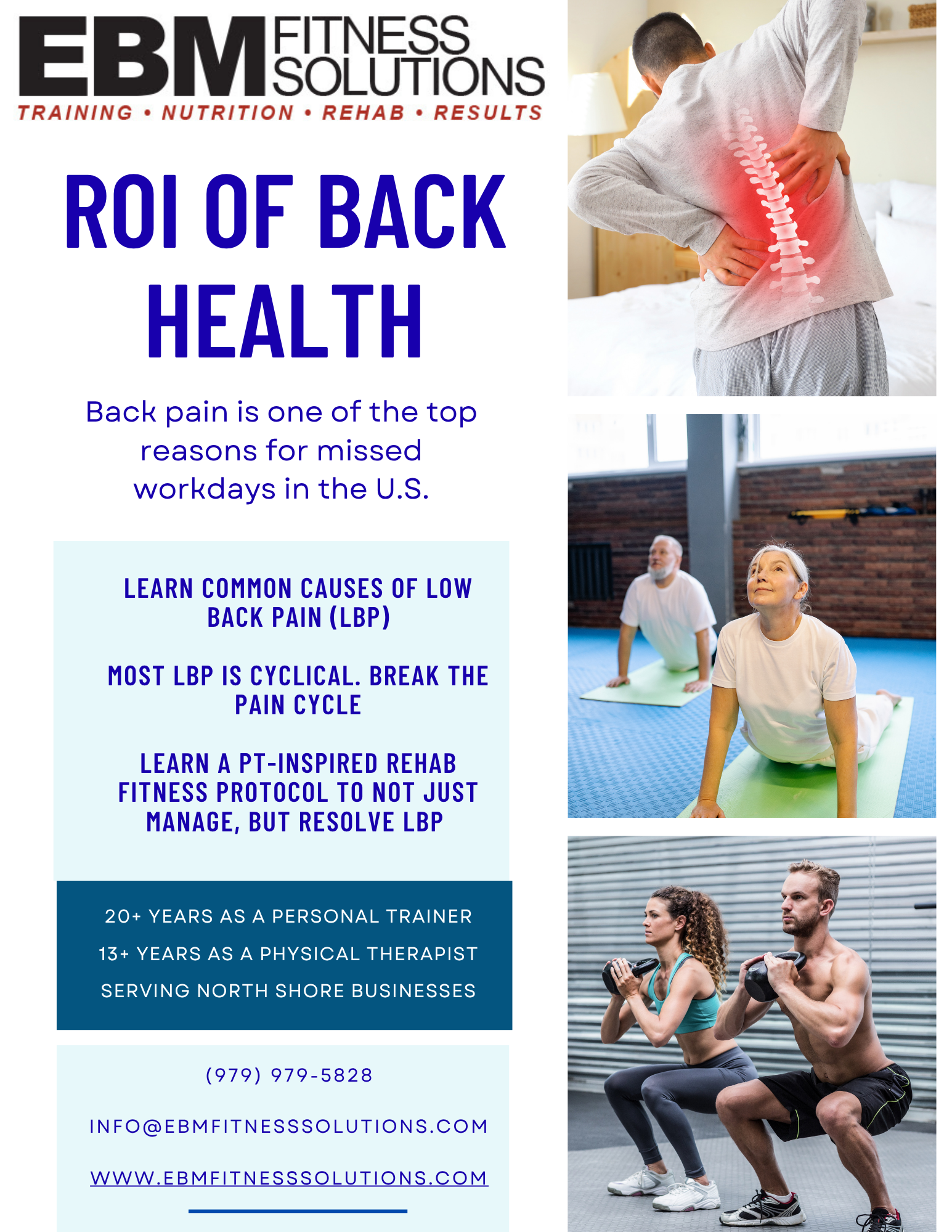
ROI of Back Health
Workshop description: Back pain is one of the most common health problems affecting the modern workforce. It impacts employees across industries — from desk-based professionals to physically demanding jobs — and it can significantly affect comfort, productivity, and overall well-being.
The ROI of Back Health workshop explores the real-world impact of back pain in the workplace and why prevention is one of the smartest investments organizations can make in employee health.
Why Preventing Back Pain Makes Business Sense
Led by a licensed physical therapist with over 13 years of clinical experience and more than 20 years in strength and fitness coaching, this workshop combines research, clinical insight, and practical strategies that employees can apply immediately.
Participants will learn:
Why back pain is so common in today’s workplaces and some of the causes of back pain
Presenteeism - the hidden ways back pain affects productivity and performance
Why many traditional approaches fail to prevent recurring pain
How strength, mobility, and movement habits influence long-term back health
Simple strategies that help reduce the risk of recurring back problems
What to stretch and what not to stretch
Pelvic tilting and why it is a big deal
How to properly stabilize the abs/core
The role of the glutes
How to properly hip hinge (and why this is critical, even if you do not know what it is)
This workshop introduces the concept of Rehab Fitness — a proactive approach that bridges the gap between rehabilitation and fitness to help people stay active, resilient, and injury-resistant.
Rather than focusing solely on treatment after problems occur, the goal is to help employees build the physical capacity needed to stay healthy and productive.
The result is a workforce that is better equipped to manage physical stress, reduce discomfort, and maintain long-term health.
The Hard Math of Back Pain
About 60–70% of people who experience back pain will have another episode within one year. Many cases become recurring rather than one-time injuries. Back pain isn’t usually a single event — it’s a cycle.
Learn how to break this cycle before the cost becomes too high.
The average cost of a single LBP workers' comp claim (often ranging from $40,000 to $80,000, including diagnostics and lost time). “Presenteeism" (working while in pain) costs U.S. employers $200+ Billion annually in lost productivity. Presenteeism is when an employee is at their desk but only functioning at 60% because their back is throbbing.
Key Learning Pillars
I - Stretching. Yes and no.
Stretching the low back rarely solves the problem causing the low back pain. Learn what to stretch instead and the best alternative to stretching for the low back.
Learn how to safely perform the following stretches:
Adductor stretch
½ kneeling hip flexor stretch
Standing hamstring stretch
Quadruped glute stretch
These stretches put individuals in safe positions that put the least amount of stress on the wrong structures, which can provoke symptoms.
Learn about lumbar spine deloading and why it is preferred to traditional low back stretches.
II - Core Stability.
Your abdominals’ primary job in the body is to stabilize your low back. A weak core is one of the best ways to develop low back pain. Learn some of the best ways to start training your core muscles as stabilizers.
Core stability exercises are not typical ab exercises. They are meant to be done slowly and deliberately to improve the neuromuscular control over the abdominals, which will, in turn, control what the low back does and does not do.
Understanding the role of pelvic tilting with these ab exercises is critical to learning the proper movement patterns.
Skipping this step often renders future ab exercises less effective.
III - Glutes.
Your glutes (also known as your butt muscles) are some of the biggest and strongest in the body. When your feet are on the ground, your glutes should be involved in almost all lower-body movements. Weakness and inhibition (diminished ability to switch on the glutes) will put undue stress on the low back. Make sure your glutes are doing the work they need to be doing.
Learn how a simple bridging exercise can start to build glute strength, aid in core stability, and start to learn the hip hinge.
Engaging the glutes and proper core stability are the foundation on which a pain-free low back is built.
IV - Hip Hinge.
In addition to the glutes being involved in almost all lower-body movements, a proper hip hinge should also be performed with most movements. Most people do not know what a hip hinge is and, therefore, are unable to perform one properly. Learn simple strategies to execute a hip hinge safely.
A proper hip hinge will bring together hip mobility, core stability, and glute activation into one well-orchestrated movement.
Don’t forget the Cheat Sheet.
Everyone attending the workshop will be able to download a FREE ROI of Back Health cheat sheet. This cheat sheet will include a summary of the presentation and video links to all movements/exercises discussed.
There is also a sample week included to help integrate these new ideas into someone’s schedule.