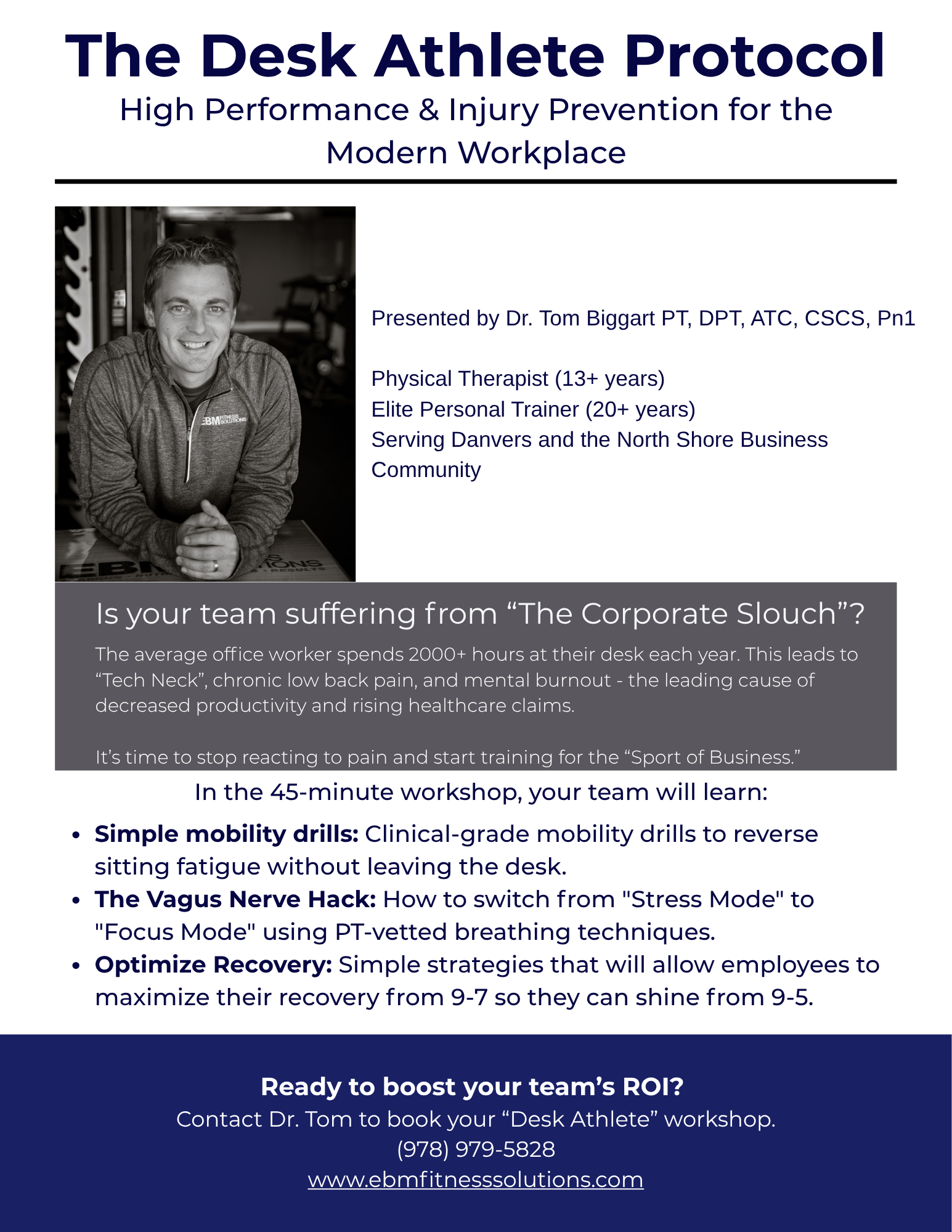
The Desk Athlete Protocol
Workshop Description: In the corporate world, your body is your most underutilized asset. Just as a professional athlete prepares their body for gameday, a "Desk Athlete" must prime their nervous system and musculoskeletal structure for the rigors of the 40-hour work week. Led by a Physical Therapist/Personal Trainer with 30 years of combined experience, this session provides a clinical roadmap to eliminating pain and boosting daily energy.
I. The Biomechanics of the "Corporate Slouch"
We pull back the curtain on what 8+ hours of sitting actually does to your physiology.
The "Upper Cross" Syndrome: Understanding why "Tech Neck" leads to headaches and shoulder impingement.
The Hip-Back Connection: Why tight hips are the #1 cause of lower back pain in office workers.
Neck Pain’s True Origin: For most people, their neck pain is a symptom, and the problem originates from a different location.
Better Than Stretching: Physical Therapy-tested strategies for dealing with neck tightness, pain, and headaches.
II. Mobility And Movement Rest
To understand the symptoms, you must understand the problem. Once you address the problem, the symptoms go away.
Thoracic Spine Mobility: Understand the importance of your midback and how dysfunction here impacts your head, neck and shoulders.
Postural Re-education: Posture is a learned behavior. Fixing it requires addressing multiple factors simultaneously.
STM For TPs: Trigger points (TPs) are painful nodules in muscles. Learn soft tissue mobilization (STM) techniques to get rid of TPs and learn why stretching won’t help.
Tight Hips = Low Back Pain: Maintaining proper hip mobility is crucial in mitigating low back pain. Learn the proper ways to mobilize the hips and manage back pain.
The Vagus Nerve Hack: Using diaphragmatic breathing to switch the body from "Stress Mode" (sympathetic) to "Recovery Mode" (parasympathetic) in 60 seconds.
III. Rest And Recovery
Performance isn't just about movement; it’s about how you recover between "sets" (meetings) and how you recover between “workouts” (workdays).
Hydration & Cognitive Function: The direct link between water intake and mental clarity.
The "20-20-20" Rule: A clinical strategy to reduce digital eye strain and mental fatigue.
The Evening Wind-down: A PT-approved routine to ensure your body actually repairs itself during sleep, so you wake up ready for the next "game day."
Each person attending the workshop will be able to download the Desk Athlete Protocol Cheatsheet, which will summarize the presentation, describe which mobility strategies to do daily and which can be done as needed (including video links), and will include an example of how to integrate these new ideas into someone’s schedule.